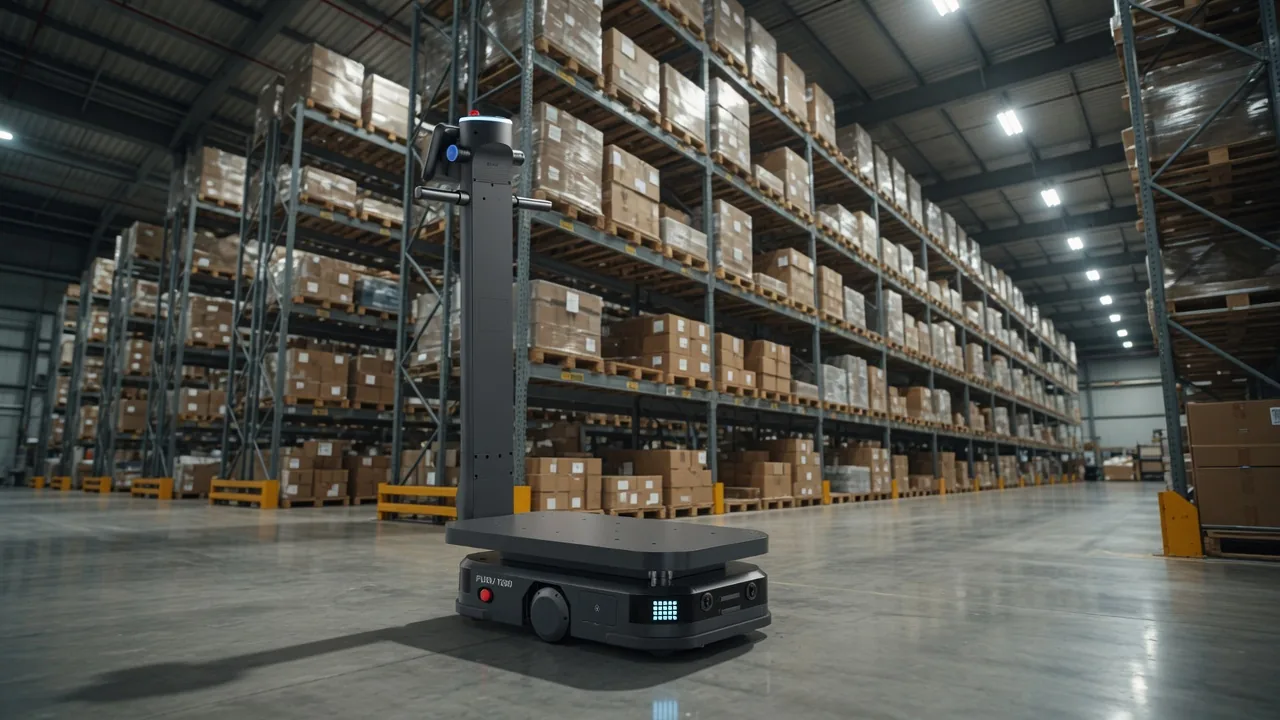
The PUDU T600 is the heaviest lifter in the lineup we sell, and it is the machine people ask about when the thing that needs moving is a loaded rack rather than a tray of plates. This review is our dealer's read on it: what the two versions actually are, what the numbers mean on a real floor, where it earns its keep, and where it does not belong.
What the T600 is, and who it is for
The T600 Series is PUDU's heavy payload transport robot. Where the delivery robots in the range carry food and supplies across a hotel or a hospital ward, the T600 moves material: loaded racks between a production line and staging, cartons from pick to pack, carts of linen or meals through a back corridor, and the repeated heavy runs that a forklift or a person with a pallet jack makes many times a day.
If your heaviest repeated move is under 300 kg, the T300 Series is the more flexible answer and usually the cheaper one. Above that, the T600 is the machine, and it comes in two shapes that behave very differently on the floor.
Payload and navigation in plain terms
Both versions carry 600 kg. A single trip moves what would otherwise take two runs of a smaller robot or one run of a forklift with a driver.
Navigation is the part that decides whether deployment is a week or a month. The Standard T600 runs VSLAM and LiDAR SLAM together, which means it maps the building on its first pass using cameras and laser scanning and then drives to that map. There is no tape on the floor, no reflectors on the walls, and no track to maintain. Routes change in software. The Underride runs LiDAR SLAM only, which suits the aisle and staging work it does.
Speed is 0.2 to 1.2 meters per second, adjustable, and positioning on a precise dock is within plus or minus 1 cm. It handles a 10 mm lip and a 35 mm gap, so expansion joints and door thresholds on a normal industrial floor are not a problem. It is rated for 0 to 40 degrees C, which covers a conditioned warehouse and a summer loading area, but not a freezer.
T600 at a glance
600 kg payload on both versions. Standard: 960 x 500 x 1350 mm, 112 kg, VSLAM and LiDAR SLAM, 70 cm minimum passage, 10.1 inch onboard screen and handle. Underride: 845 x 500 x 255 mm, 94 kg, LiDAR SLAM, 65 cm minimum passage, no screen. 30 Ah battery, about 12 hours unloaded, 0 to 90 percent in about 2 hours. VDA5050 fleet protocol, on premises deployment, rack group recognition, idle elevator priority. MSRP from $23,000.
The Underride and the pallet workflow
PUDU's own name for the second version is the T600 Underride, and the word is exact: it rides under. The chassis is 255 mm tall, which is low enough to travel beneath a rack unit, stop at the center, lift the whole rack clear of the floor, and carry it away. At the destination it lowers the rack and backs out. There is no loading step, because the load never leaves the rack it is already on.
That is what makes it the pallet conversation. Donny, who takes most of these calls, puts it this way as Tovrana's own view:
Almost everyone who calls us about the T600 is moving loaded racks, not boxes. The underride version is the one that changes the conversation, because it slides under the rack you already have and lifts it. No repacking, no new tray, and no more forklift forks punching holes in the side of a box.
The practical version of that sentence is a question about what your pallets sit on. The Underride lifts from the center of a rack it can get beneath, so a pallet on a wheeled rack, a dolly, or a compatible stand is a one step move: drive under, lift, go. A bare pallet flat on the concrete is a different job, and it is worth saying so plainly, because the honest answer to "can it take my pallets" is "yes, on the carrier we agree during the site walk." We map the carriers you already use before anyone quotes anything.
The Underride's other trick is rack group recognition. The robot identifies the target rack among a group of them and runs the pick and place on its own, which is what turns a transport robot into an unmanned workflow rather than a machine somebody has to line up by hand. The 65 cm minimum passage, five centimeters tighter than the Standard, is what lets it work the narrow aisles where the racks actually live.
Where it earns its keep
Warehouse. The clearest case is the fixed shuttle: pick to pack, dock to storage, storage to a staging lane. Those are long, boring, heavy, and repeated all day, and every one of them is a trip a person or a forklift is not making somewhere else. The narrow aisle logic switches between single lane and dual lane traffic so several robots can share a tight run. Our logistics page covers how we plan a floor like that.
Manufacturing. Line side delivery is where a 600 kg payload starts to pay quickly: kitted parts to a station, finished sub assemblies to the next cell, empty racks back. The VDA5050 support matters most here, because a plant that already runs compliant vehicles can schedule the T600 in the same fleet manager with no custom integration. See our manufacturing page for the way we approach a plant floor.
Hospital back of house. Meal carts, linen, and supply racks move between the loading dock, central supply, and the wards every day, and they are heavy. The T600 does that run through service corridors and, with the building's elevator integration, across floors, calling an idle car first so a cross floor trip does not sit in the lunchtime queue. This is back of house work, out of the patient's sight, and it is exactly the kind of lifting that wears people out.
Logistics. Loading zones and covered yards with long runs between staging and the dock use the same fixed shuttle logic, inside the limits below.
What it does not do
It is not a forklift. The T600 lifts a rack a short distance off the floor to carry it; it does not raise a load to a shelf, stack pallets, or reach into racking. Anything vertical stays with the forklift and its driver.
It is not an outdoor vehicle. Covered yards and loading areas within its temperature range are fine. Rain, rough ground, and cold stores are not.
It does not carry more than 600 kg, and it does not take a bare pallet off the floor without a carrier it can get under.
And it does not fit every aisle. The Standard needs 70 cm of passage and the Underride 65 cm. The places that catch people out are doorways, ramps, and the gap between a column and a machine guard.
Deployment realities
Mapping is fast because there is nothing to install on the floor. The longer part of a T600 deployment is the workflow around it: agreeing the carriers, marking the pick and drop points, deciding who calls a run and from where, and connecting the fleet software to whatever already schedules the floor. The Standard has an onboard touchscreen and handle, so a station worker can dispatch it locally with no central system at all; the Underride has no screen and is driven by the scheduler, which is the right design for an unmanned rack loop.
Security teams like the on premises option: the whole system can run on your own servers with no cloud dependency.
Battery planning is simple: about 12 hours unloaded, two hours back to 90 percent, and automatic docking or a battery swap for a floor that cannot wait. Safety is layered: LiDAR, RGBD cameras, and bumpers for obstacle avoidance, a floor projected warning ahead of the robot, and a module that takes a fire alarm signal and parks the robot somewhere safe.
Most operators finance rather than buy; our financing page explains the package we prepare.
Verdict
The T600 Standard is a very good heavy shuttle for a floor that wants local control and a screen at the station. The T600 Underride is the one we recommend most often, because the rack lift removes the loading step entirely and that is where the labor actually goes. If your heavy moves are repeated, on carriers, and inside a building, it is the strongest case for a transport robot in the range. If they are occasional, vertical, or outdoors, keep the forklift.
Watch it work on the T600 watch page, then ask us to walk your floor. We will map the lanes, confirm the carriers, and put a number on the trips it would take.
Frequently asked questions
What is the difference between the T600 Standard and the T600 Underride?
The Standard is a 1350 mm tall column robot with an onboard 10.1 inch touchscreen and handle, so a person can dispatch it at the station. The Underride is a 255 mm tall chassis with no screen that drives beneath a rack, lifts it from the center, and carries it, run by the fleet scheduler. Both carry 600 kg.
Can the PUDU T600 Underride move pallets?
Yes, when the pallet sits on a rack, dolly, or carrier the robot can drive under and lift from the center. A bare pallet flat on the floor needs a carrier first, which we agree with you during the site walk.
Does the T600 need floor tape, tracks, or markers?
No. The Standard maps with VSLAM and LiDAR SLAM and the Underride with LiDAR SLAM, so routes live in software and change without any work on the floor.
How long does the T600 run and how fast does it charge?
About 12 hours unloaded on its 30 Ah battery, and from 0 to 90 percent in about two hours, with automatic docking or a battery swap for floors that cannot wait.
See it in your space
Book a live demonstration and we will prepare a full ROI and finance proposal.
Request a demo Explore the robotsGet the Clean Sheet weekly
Practical guidance on commercial cleaning and service robots, one email a week. No spam, and you can unsubscribe any time.